

Now, I bet when you woke up this morning you never thought that reading about roofing software would be something you'd be doing today but alas, here you are.
It's acutely crazy that this simple, somewhat boring, industry presents a huge $20,000 per month opportunity and in this article we are going to cover the opportunity in detail, how you can take advantage of it and where to start.
TL;DR
When I stumbled across a job post asking for custom roofing software, I assumed the problem had already been solved. Turns out I was wrong...
After digging into the market, I found an industry dominated by expensive, outdated software that frustrates users with poor mobile apps, limited integrations, clunky workflows, and features locked behind high-priced plans. Better yet, the same complaints appear across almost every major competitor.
The opportunity? Build a simple, modern, AI-powered roofing platform that solves the problems roofers actually complain about. With strong search demand, high software pricing, and a niche that's surprisingly underserved, even a relatively small customer base could grow into a business generating $20,000+ in monthly recurring revenue.
Key Takeaways
🏠 1. Boring industries often hide the biggest opportunities.
Roofing isn't exciting, but it's a multi-billion dollar industry where businesses happily pay $100–300+ per month for software that many users aren't completely satisfied with.
🤖 2. Don't build another CRM, fix the workflow.
Users consistently complain about mobile apps, photo management, integrations, reporting, and manual admin. AI can automate much of this and create a genuinely better experience instead of simply adding more features.
📈 3. Validation comes before code.
Talk to roofers, build with them, and focus heavily on distribution through influencers, SEO, and customer feedback.
Introduction
I spend a lot of my time on various platforms online because I am always building, shipping marketing ect and one of them is Upwork, which is where my initial discovery of this industry came from.
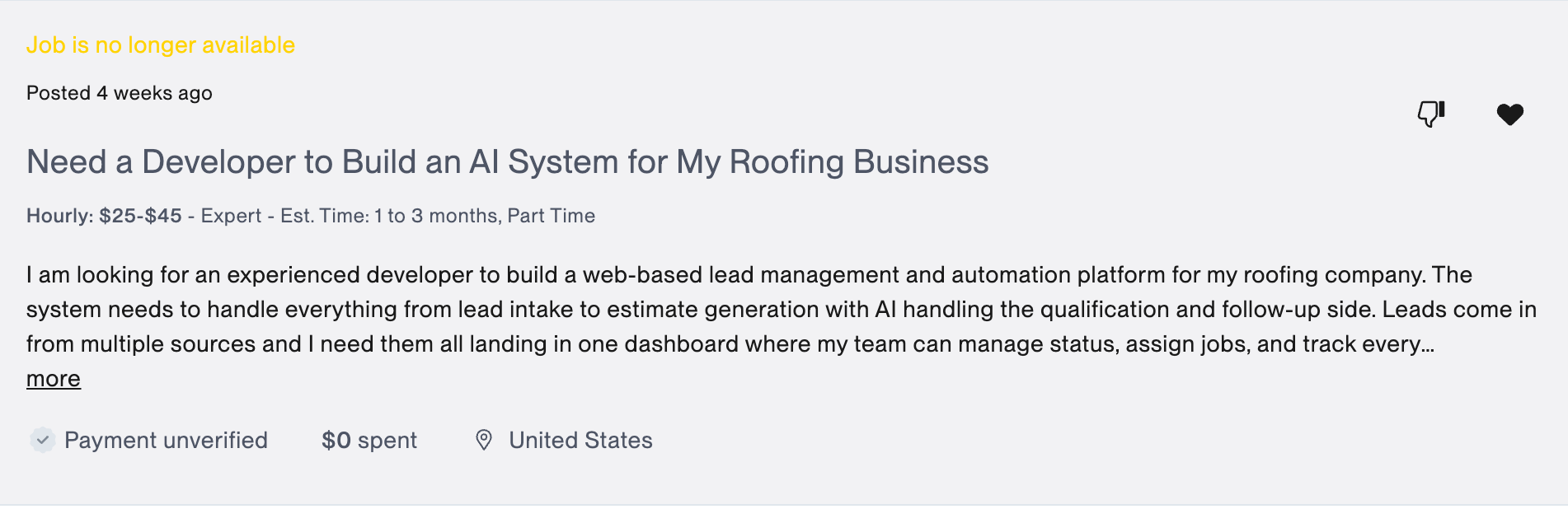
I discovered a listing for creating a software application for a roofing company based in the US. Now before applying to it, I decided to do some further research into the industry as my initial question was: why don't they use something that already exists? I mean, surely, this is a problem that has been largely solved.
What I found though was an industry full of players with software that is largely out of date and behind the times, clearly because they have no need to develop their software due to a lack of competition.
Roofing software competition
The market is mainly made up with large players who sell old, expensive software with the market leader being Roofr.
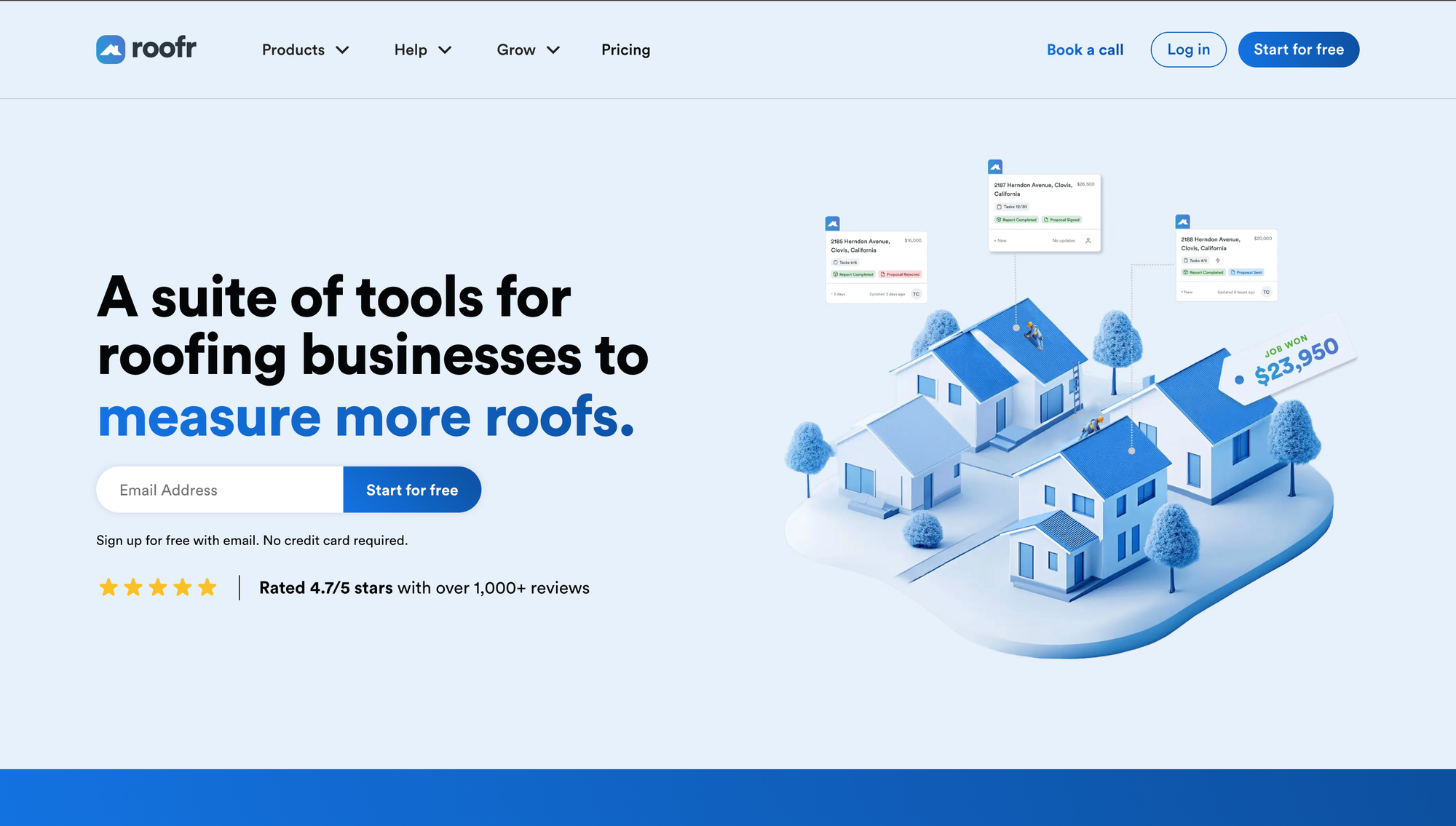
Roofr does have a lot of great reviews online, especially around price and being a cost effective solution for small companies however, it has a lot of issues too.
Comments like the one found on reddit below are quite common in the subreddit for roofing businesses and many companies and employees are looking for something different.
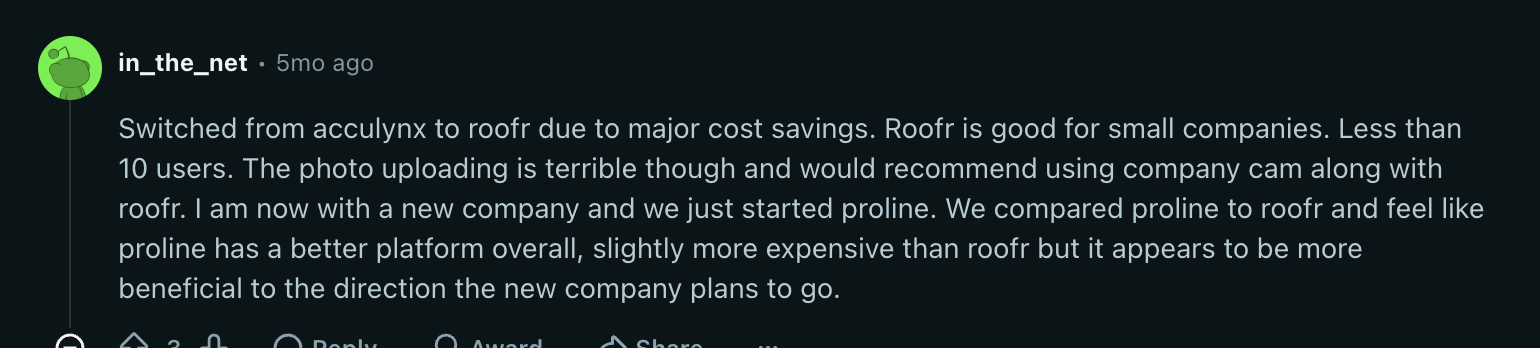
A common complaint photo uploading which is a common practice amongst roofing companies and is vital to their business as its used both to communicate with customers but also for pricing and cost reasons.
Common Issues with roofr
| Category | Common User Complaints | Examples / Evidence | Potential Opportunity |
|---|---|---|---|
| 1. CRM feels incomplete | Users like having CRM, measurements and proposals in one place, but still rely on other software. | Missing QuickBooks integration, cumbersome expense management, limited reporting, no weather tracking, basic team management. | Build a truly all-in-one platform with accounting, reporting, automation, weather intelligence and stronger operations management. |
| 2. Mobile experience | The mobile app is considered slower and less capable than the desktop experience. | Only one photo can be uploaded at a time, measurements are difficult to create on mobile, occasional UI bugs. | Create a mobile-first experience with bulk photo uploads, offline support and faster field workflows. |
| 3. Image & photo limits | Upload limits become restrictive for larger roofing jobs. | Lower pricing tiers limited to around 50 files per job; many projects require hundreds of photos. | Offer generous or unlimited photo storage and easier photo organisation without forcing users onto expensive plans. |
| 4. Pricing | Important functionality is locked behind expensive plans. | Elite plan (~$350/month), automation restricted to higher tiers, lower plans missing key features. | Simpler pricing with core functionality included and fewer artificial limitations. |
| 5. Measurement accuracy | Measurements are generally good but shouldn't be blindly trusted. | Incorrect roof pitches, inaccurate square counts, poor performance on complex roofs or low-quality imagery. Experienced users recommend verifying every report before quoting. | Improve AI measurement accuracy and confidence scoring, highlighting uncertain areas for manual review. |
| 6. International support (especially UK) | Product is heavily focused on North America. | Limited UK coverage, phone number validation issues, satellite imagery limitations, missing regional functionality. | Build a platform with strong international support, local suppliers, regional pricing and wider mapping coverage. |
| 7. Missing integrations | Businesses still need additional software because integrations are lacking. | Requests for QuickBooks, supplier integrations, accounting software and automation platforms. Existing integrations (e.g. SRS) aren't always seamless. | Invest in an open integration ecosystem with accounting, suppliers, CRMs and automation tools. |
| 8. Customer support | Experiences vary significantly. | Some praise support, while others report slow responses, unresolved technical issues and poor escalation processes. | Differentiate with faster response times, dedicated account managers and proactive customer success. |
| 9. Market sentiment (Reddit) | Roofers don't necessarily want more CRMs—they want existing workflows to work better. | Comments such as "We don't need anymore CRMs." and "The market is flooded." indicate frustration with feature bloat rather than lack of options. | Focus on solving real operational problems, reducing admin, and improving execution instead of simply adding more features. |
Sources For The Table Above
- Anyone using measuring software UK?
- Starting a roofing company – What CRM do you use?
- Unhappy with current CRM
- Roofing estimating software
- What CRM are roofing companies using to manage leads and jobs?
- Best CRM for a Roofing Business
Review Platforms
As well as Roofr there are a few other players in the market. Here is a quick overview:
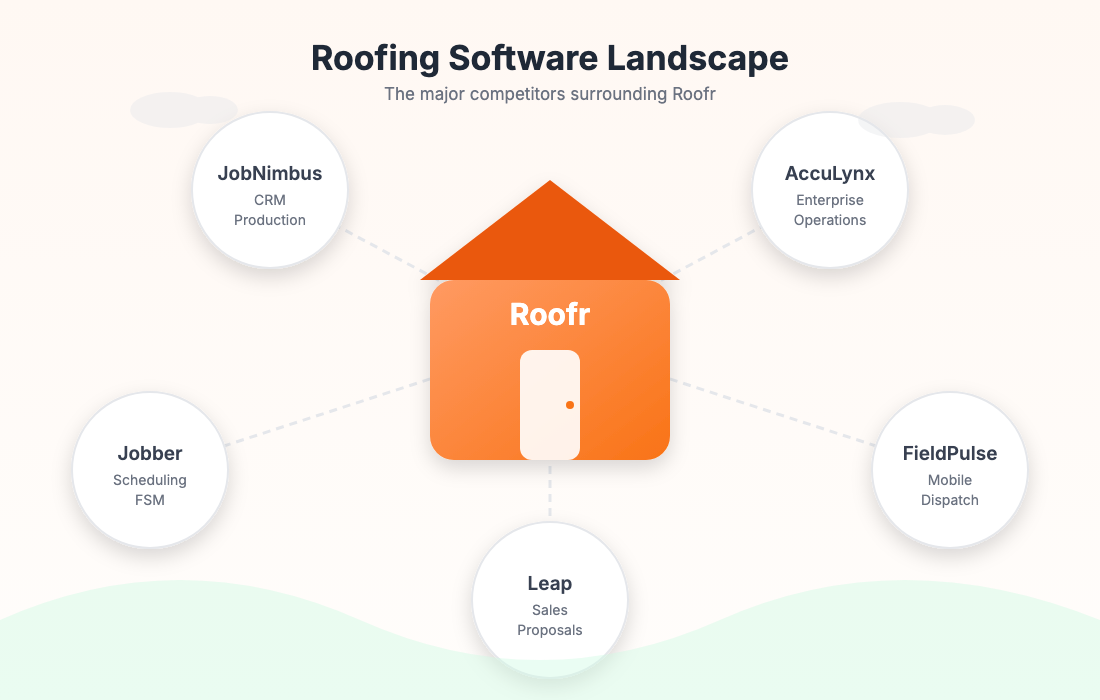
Common issues across competitors
A clear sign that the industry software is stagnant and well positioned for someone to come in and shake things up is that, during my research, I found that the issues companies and people had with Roofr were a common theme across more or less all of its competitors.
- 💰 Pricing – Most platforms lock important features behind expensive plans. This makes it really difficult for new companies and smaller businesses.
- 🔗 Integrations – Users want better QuickBooks, supplier, and accounting integrations.
- 📱 Mobile apps – Field users expect faster, more capable mobile experiences.
- 📊 Reporting – Dashboards and business analytics are often too basic.
- 🤖 Automation – Manual admin work remains a major frustration. AI is something that can help with this as well as simply implementing better UX.
- 📸 Photo management – Roofing businesses generate hundreds of photos per job, and many platforms struggle with uploads, organisation, or storage limits.
- 🎓 Ease of use – Powerful platforms often become complicated to learn and configure.
- 🏠 Roofing-specific workflows – Some roofing companies are resorting to using general, somewhat related software but this software often misses insurance claims, roof measurements, material calculations, and supplier integrations that roofers need.
These recurring pain points suggest there is still room in the market for a platform that combines a simple UX, AI-powered automation, strong mobile experience, deep accounting/supplier integrations, and roofing-specific workflows without the complexity or pricing frustrations users frequently mention.
Here is an acctual job post that a roofing company posted on Upwork, requesting for software to be built that literally helps with the issues mentioned above. I have highlighted the important text in orange.
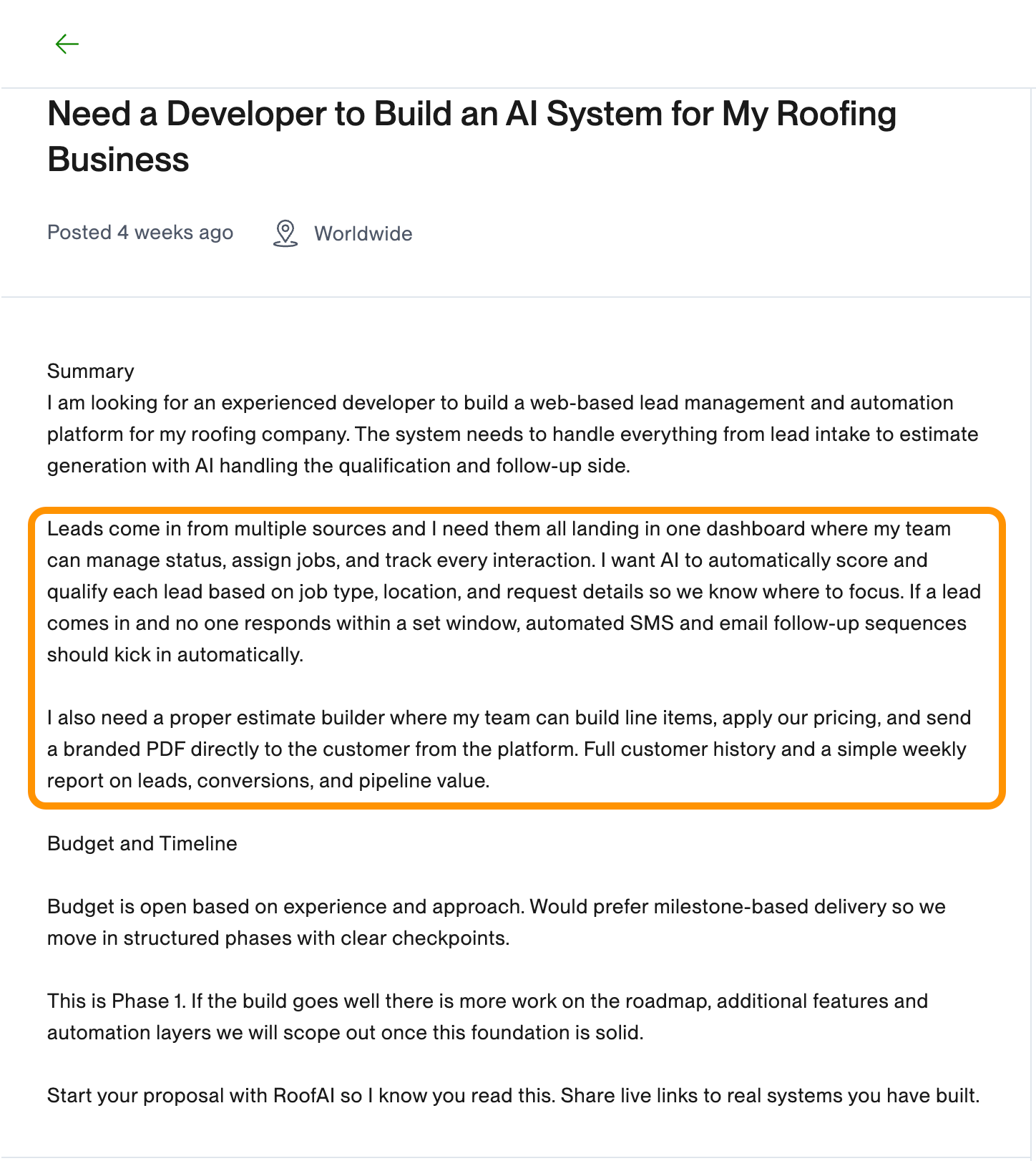
The post mentioned "I want AI to automatically score and qualify...." showing a clear demand for automation of Admin tasks. It also highlights the need for proper estimation of line items and other supplier related issues.
Whoever nails this down is going to gain access to a huge customer base. I mean, just take a look at the numbers...
The Roofing Market
I am going to start by just showing you the sheer volume of searches that roofing software gets. Specifically Roofr.

Roofr gets an average of 30,000 monthly searches, that is 30,000 people per month using just one software product for roofing businesses, not to forget it also has a low keyword score meaning that there is potential to run cheap targeted ads at that keyword.
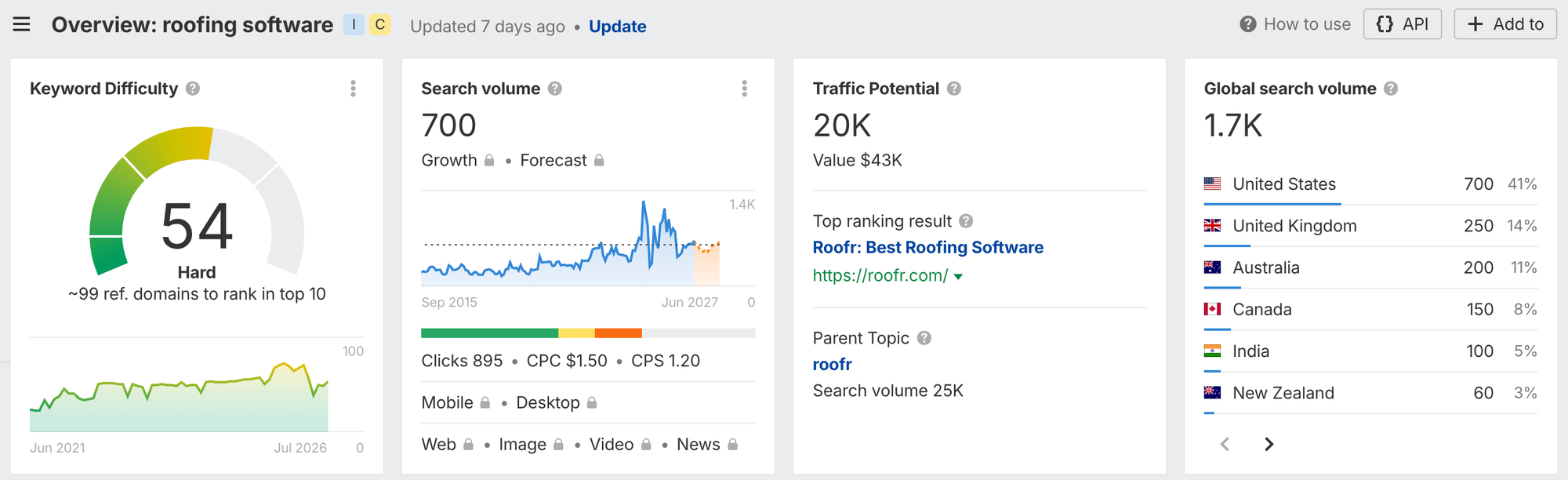
The global search volume for the term "Roofing Software" also shows very high demand. You can see a total global search volume of 1,700 searches per month with a traffic potential when accounting for similar search terms of 20,000 per month.
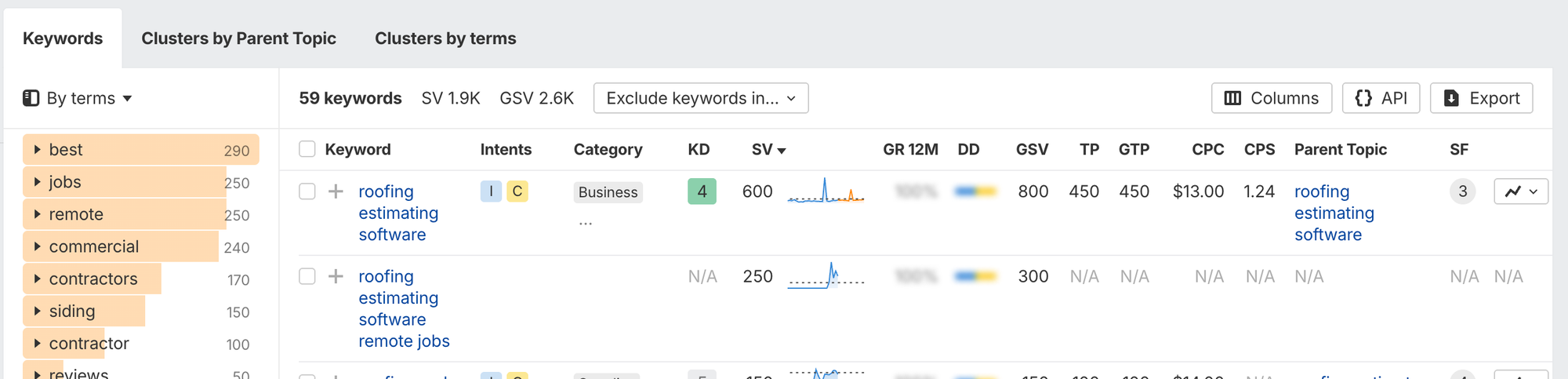
Roofing estimation software also has great search volume too, coming in with a global search volume of 2,800 searches per month and 1,900 searches per month in the US.
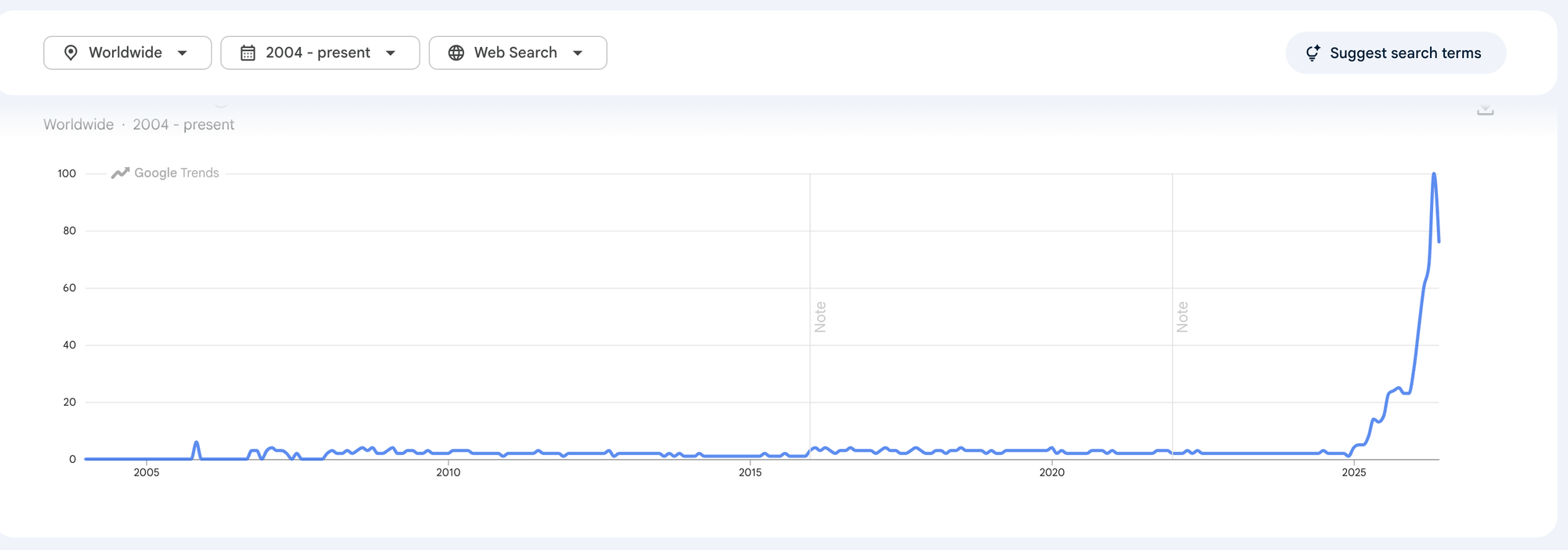
If you look at Google trends data for roofing software you will also see a huge spike since 2025 for the demand of roofing software. It has also been a very steady industry since 2007.
Market Value
The size of the roofing industry in the US blew my mind when I first read about it. Here is a crazy stat for you. According to Freedonia Group(specialises in market research) world, the roofing market in the us is estimated to be worth $22.6 billion.
I mean, it makes sense when you think about it, construction of buildings, offices, data centres ect all needs roofs and who lays those roofs? Roofing contractors of course.
The same report also found this breakdown of the market share.
| Segment | Typical Share |
|---|---|
| Residential roof replacement | 45–50% |
| Residential repairs | 15–20% |
| Commercial roofing | 25–30% |
| New construction | 10–15% |
Typical pricing
Here is a breakdown of the pricing structures for the various software products operating in the market.
| Company | Typical Monthly Cost |
|---|---|
| Roofr | $49–$349/month depending on tier |
| JobNimbus | ~$225–300+/month (quote-based) |
| AccuLynx | ~$250+/month (often higher with users/add-ons) |
| Leap | ~$79+/user/month (quote-based for larger teams) |
| Jobber | $39–129/month depending on plan |
| FieldPulse | ~$99–199+/month depending on users/features |
This could mean you could price competitively here, while maintaining a good enough margin, its also perfect if you want to bootstrap the business because the lowest price is $39 per month, meaning expectations of resonable prices are lready there.
Lets say you want to generate $2,000 per month to cover your expenses, well you only need to get 52 paying users at $39 a month to get there. Personally though, I think you could charge more.
So what can you expect to make if you build a SAAS product for this industry?
Referencing back to the search demand we looked at earlier, we can safeley estimate that across thousands of keywords there is high traffic potential of 10,000 visits to your software product per month.
We are going to use standard metrics that are used across the industry to estimate the amount of revenue you could generate.
Base conversion rate - (This is the percentage of people who land on your website and then sign up. They don't purchase anything but they sign up and start using your product) - 2.4%
Conversion to customer - (This is the amount of people who convert from a user into a paying customer) - 30%
10,000 visits equates to 240 users per month who convert.
240 users x 0.3(30% conversion rate) = 72 paying users per month
Looking at the pricing above, a good pricing point for a product that incorporates AI, improves the UX and solves the core issues a user is facing could easily charge $99 per month.
72 x 99 = $7128 per month
Lets look at how that would look over a 1 year period, accounting for a high monthly churn of 35%.
After 1 year you would be doing $20,250 MRR.
- New customers acquired: 864
- Monthly recurring revenue after 12 months: $20,250 MRR
- Active paying customers after 12 months: 205
- Total revenue earned over the first year: $206,782
Here is a monthly detailed breakdown
| Month | New Users | Active Customers | Monthly Revenue (USD) |
|---|---|---|---|
| 1 | 72 | 72.00 | $7,128.00 |
| 2 | 72 | 118.80 | $11,761.20 |
| 3 | 72 | 149.22 | $14,772.78 |
| 4 | 72 | 168.99 | $16,730.31 |
| 5 | 72 | 181.85 | $18,002.70 |
| 6 | 72 | 190.20 | $18,829.75 |
| 7 | 72 | 195.63 | $19,367.34 |
| 8 | 72 | 199.16 | $19,716.77 |
| 9 | 72 | 201.45 | $19,943.90 |
| 10 | 72 | 202.94 | $20,091.54 |
| 11 | 72 | 203.91 | $20,187.50 |
| 12 | 72 | 204.54 | $20,249.87 |
This is also very easily increased by focusing on reducing churn and acquiring new customers but, this would give you a great base from which to start.
Okay, now I have hopefully sold you the dream, how do you acutely get started with this idea?
How to get started building a Roofing SAAS Business
Building this business you are going to want to target a few different areas. Firstly, we need to establish the following:
- A feedback loop - How do we get get feedback from users?
- Features - What do we build?
- Distribution - How do we get the product in front of users?
Feedback loop
One benefit to this business is that you can most likely take advantage of in person relationships because finding roofers is going to be quite easy to do in more or less any town or city.
If I were building this, I'd get outside, I'd go looking for people in my town or city who are getting their roof laid and just start up a conversation with the people who are laying the roof. Crack a few jokes, probably not make any of them laugh but hey, at that point you are chatting with them, even if its out of pitty.
The goal of chatting with them though is to find out who owns the business, if they have used any apps or software to help them, find out their processes and any other information that will help you understand and emphasis with there issues. Listen deeply to what they tell you, especially if they start moaning. Tell them what you are doing and see what they say, if you do this enough times, you will eventually get roofers who will be your first product testers and be ideal for getting feedback for features that you build.
Features
Speaking of features, I'd keep it simple here. Based on the initial research we looked at earlier, improving the UX is something worth focusing on. I'd acutely build the following first:
- AI Lead functionality - AI can handle a lot of the admin work and its a premium feature, adds a lot of value because it prevents roofing companies from missing out on revenue.
- Estimation Builder - This was something that a lot of people asked for or had issues with in other platforms.
- Photo Management - Another issue is ensuring that companies get good photo management. Huge issue with Roofr and something that people actively complain about on reddit.
- Simple Mobile App (You can use React Native) - This would be required, most likely for employees but also to take pictures of peoples roofs.
This would make a great base and be ideal for product demos. You can then use this to actively engage potential customers with a demo.
Distribution
Getting your first users will likely come from earlier steps but scaling into a profitable business is going to require quality distribution channels.
One obvious option is SEO & AEO optimisation due to the insane amounts of search around this product. This will likely take time though and, in my opinion, should be your second distribution option for this business.
I'd put time into finding influencers who work in this niche, think the pool guy on youtube but for roofing (if you get that reference you spend too long on Youtube).
Doing this has two benefits. One, you of course get access to direct distribution to customers but two, you also get feedback from people who work with roofing software and will help you improve the product, they are literally incentivised to do so as it means more income for them.
In the age where AI lets you build more or less anything, distribution is key to success, though it always has been, now more than ever, its of huge importance in order to ensure you get seen ahead of all the other software being churned out.
Prioritise distribution over everything at first! You can thank me later when it works, if for some reason it does not, this advice never came from me 😉.
Distribution Plan
Step 1 - Influencers, get them involved as early as you can, join any online groups they may have and participate, try to form relationships with them too.
Step 2 - SEO & AEO, there is a huge opportunity here, if you need a reminder, the keyword "Roofing Software" gets 20,000 a month in global searches.
Step 3 - Ads, This is the final stage but it works best here because at this point you have had enough users on your website to acutely get a pixel to build enough data on them so that when you spend money on ads, it reaches your ideal customer profile quickly.
Conclusion
Now that I have drilled this niche industry into your head for the last ten or so minuets, its time for me to tell you to get building. This is an ideal opptunity for someone who wants to build a bootstrapped SAAS product in a niche industry that currently does not poses a lot of new competition.
Why is it that it does not have a lot of competition? Likeley because, for your average Joe, me included, its extremely boring. However, boring makes money, people who come into entrepreneurship these days seem to be chasing glamor, if you want glamor move to LA, if you want to make money, creating a CRM for roofing seems to be a great option for you.
